
BigCommerce builds, tuned end to end.
Custom Stencil themes, headless storefronts and multi-channel setups on BigCommerce, built for B2B catalogues and price lists from day one.
BigCommerce earns its place when a catalogue gets complicated — customer-specific pricing, large variant counts, B2B approval flows and several sales channels pulling from one inventory.
We build on its native architecture rather than fighting it, and go headless when the storefront genuinely needs to.
Tell us about your store
Thanks, .
Your details are captured in this preview. Connect this form to your CRM or email endpoint before launch so requests reach the team.
Built for complex catalogues and B2B rules
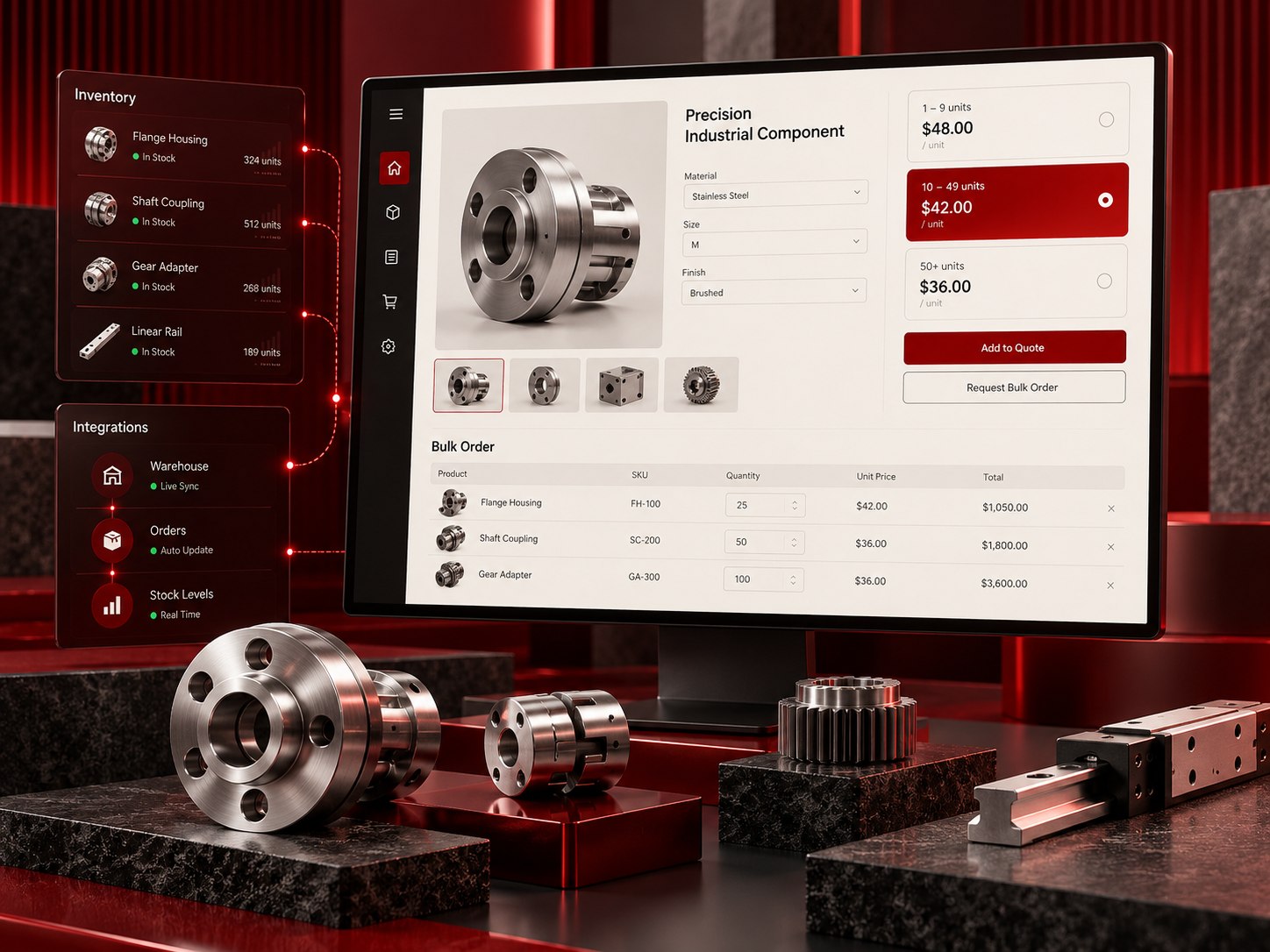
Most platforms handle a simple catalogue well. BigCommerce is chosen when the rules get harder: price lists per customer group, bulk pricing tiers, quote workflows and product data that has to stay consistent across marketplaces.
We set that structure up properly at the start — product data model, variant strategy, price lists and channel configuration — because it is painful to restructure once orders are flowing.
Custom Stencil themes keep the storefront fast and on-brand, and where the front end needs more freedom we build headless against the Storefront API.
What’s included
Fixed scope agreed in writing before we start, so you know exactly what is delivered and when. Anything outside it is quoted separately rather than absorbed quietly.
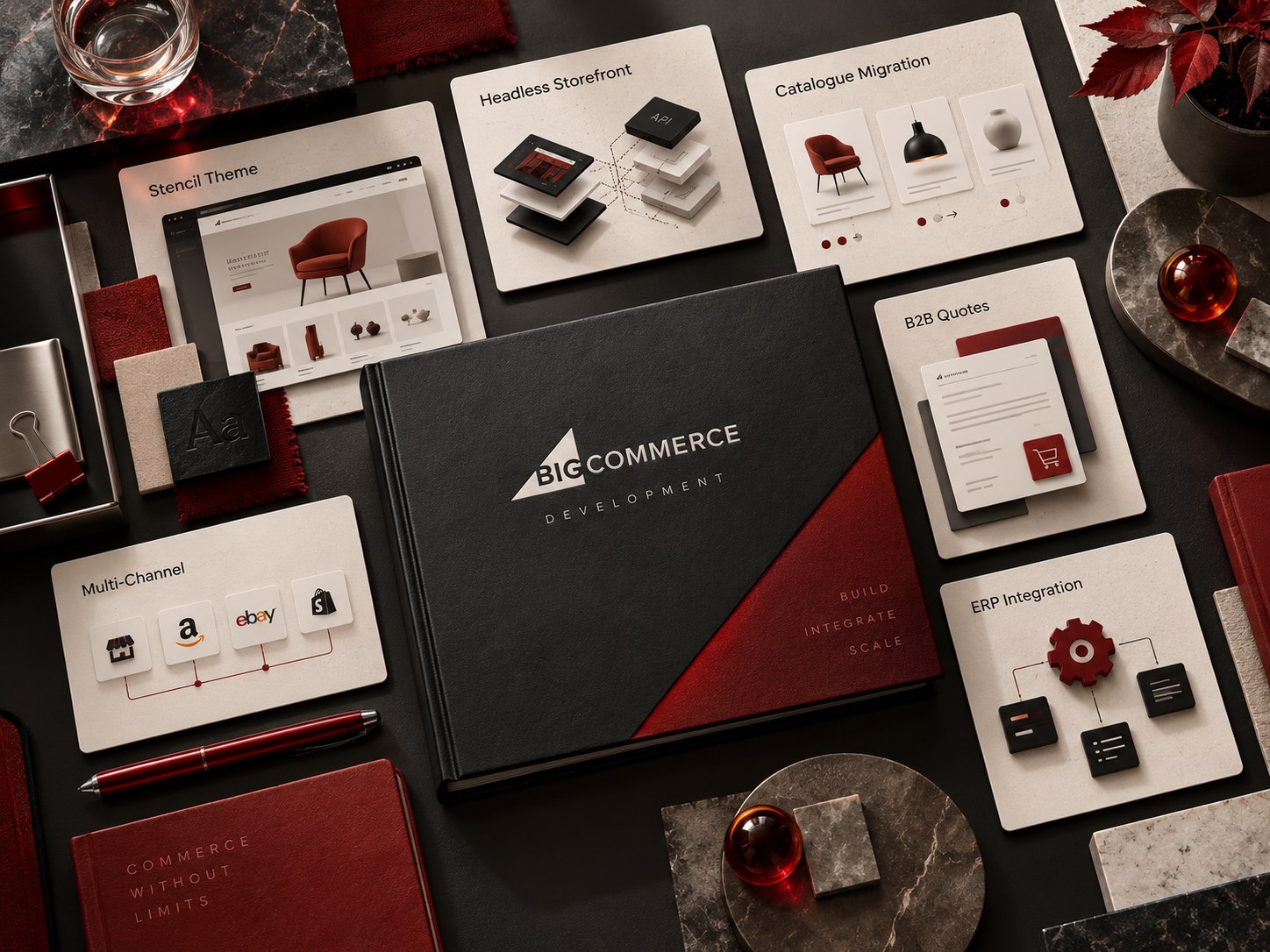
- Custom Stencil theme development
- Headless storefront builds
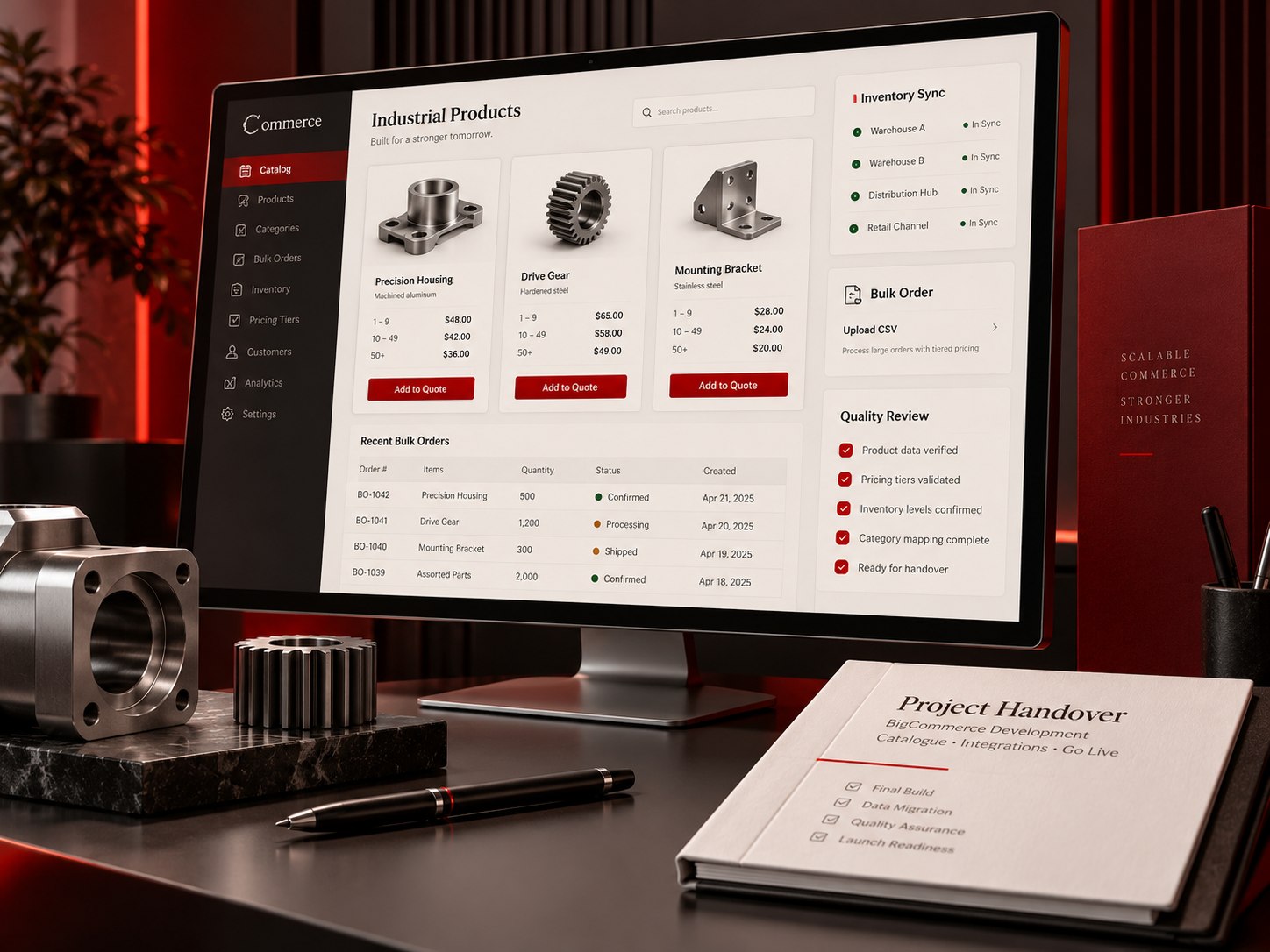
- Catalogue and variant migration
- B2B price lists and quotes
- Multi-channel and marketplace setup
- ERP and app integration
Let’s talk BigCommerce.
Tell us where things stand today and we’ll reply within one business day with an approach and a realistic estimate.
Why brands keep building with us
Plenty of agencies hand over a website and disappear. We are still here six months later, because the people who designed and built it are the same people who pick up when something needs changing.
Everything happens in-house. Strategy, design, engineering, content and marketing sit in one team of 200+ specialists, so nothing falls through the gap between disciplines.
Over ten years we have launched and grown more than 500 brands across the US, UK, Canada and Germany. You get one point of contact, a staging site you can click through at every milestone, and documentation you own outright.
From scope to stable release
Short sprints, shared boards and a staging site you can click through at every milestone.
Requirements
Features, integrations and success metrics agreed in a written specification.
Prototype
Clickable prototypes validate flows on real devices before development begins.
Develop & test
Sprint-based development with code review, automated checks and QA.
Release & support
Zero-downtime launch, redirects verified, analytics wired and a support plan that fits.
BigCommerce Development questions
Scope, timelines, ownership and what we need from your side.
For large variant counts, native B2B price lists and quote workflows, and no transaction fees on third-party gateways. For simpler D2C catalogues Shopify is usually the easier choice.
Yes — products, variants, customers, orders and content, with URL mapping and redirects so search rankings carry across.
When it is justified, typically for content-heavy brands or unusual merchandising. For most stores a well-built Stencil theme performs just as well.
Yes. Customer groups, price lists and gated catalogues let one store serve both audiences with different pricing and visibility rules.